h-index: 6     i10-index: 4

Carbon Balance in Soil, Air, and Cereal Crops: Crop Physiological Responses and Agronomic Strategies to Mitigate Climate Change and Sustain Productivity

Document Type : Review Article

Author

School of Plant Sciences, College of Agriculture and Environmental Sciences, Haramaya University, Ethiopia

10.48309/jase.2025.551776.1093
Abstract
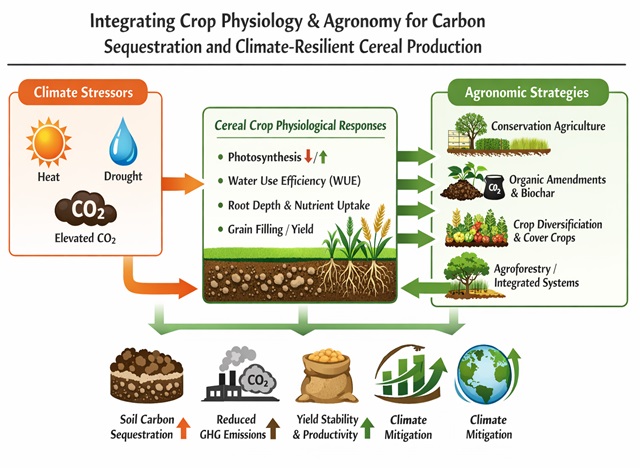
This comprehensive review examines the critical interactions between climate change, carbon balance, and cereal crop productivity, with a strong emphasis on carbon sequestration and climate-smart agricultural practices. Climate change poses substantial risks to cereal-based food systems through increased frequency and intensity of drought, heat stress, and variability in rainfall patterns, leading to yield instability and declining soil health. To sustain cereal productivity and global food security, adopting climate-resilient crop varieties, improved nutrient and water management, and soil conservation practices are essential. The review highlights the role of soil carbon sequestration as a key climate mitigation strategy, emphasizing the contribution of conservation agriculture, organic amendments, diversified cropping systems, and biochar application in enhancing soil organic carbon stocks while reducing greenhouse gas emissions. Crop physiological responses to climate stress, including changes in photosynthesis, water-use efficiency, and nutrient uptake, are discussed in relation to their influence on carbon dynamics and yield formation. Despite the mitigation potential of these approaches, significant challenges remain in their large-scale adoption, particularly in smallholder farming systems. Integrated strategies that combine crop breeding, agronomic management, and supportive policy frameworks are therefore crucial for developing resilient, productive, and environmentally sustainable cereal production systems under a changing climate.

Graphical Abstract

Carbon Balance in Soil, Air, and Cereal Crops: Crop Physiological Responses and Agronomic Strategies to Mitigate Climate Change and Sustain Productivity

Keywords

Subjects

OPEN ACCESS

©2026 The author(s). This article is licensed under a Creative Commons Attribution 4.0 International License, which permits use, sharing, adaptation, distribution and reproduction in any medium or format, as long as you give appropriate credit to the original author(s) and the source, provide a link to the Creative Commons license, and indicate if changes were made. The images or other third party material in this article are included in the article’s Creative Commons license, unless indicated otherwise in a credit line to the material. If material is not included in the article’s Creative Commons license and your intended use is not permitted by statutory regulation or exceeds the permitted use, you will need to obtain permission directly from the copyright holder. To view a copy of this license, visit: http://creativecommons.org/licenses/by/4.0/

PUBLISHER NOTE

Sami Publishing Company remains neutral concerning jurisdictional claims in published maps and institutional affiliations.

CURRENT PUBLISHER

Sami Publishing Company
[3] Tubiello, F.N., Rosenzweig, C., Conchedda, G., Karl, K., Gütschow, J., Xueyao, P., Obli-Laryea, G., Wanner, N., Qiu, S.Y., De Barros, J., and Flammini, A. Greenhouse gas emissions from food systems: building the evidence baseEnvironmental Research Letters2021, 16(6), 065007.
[4] Lal, R. Regenerative agriculture for food and climateJournal of Soil and Water Conservation2020, 75(5), 123A-124A.
[5] Paustian, K., Lehmann, J., Ogle, S., Reay, D., Robertson, G.P., and Smith, P. Climate-smart soilsNature2016, 532(7597), 49-57.
[6] Batjes, N.H. Total carbon and nitrogen in the soils of the world. European Journal of Soil Science, 1996, 47(2), 151-163.
[7] Lal, R. Soil carbon sequestration impacts on global climate change and food security. Science, 2004, 304(5677), 1623–1627.
[8] ISRIC. SoilGrids v2.1 Global Soil Carbon Dataset. Wageningen, Netherlands: International Soil Reference and Information Centre, 2025.
[9] Perennial. Soil Ecosystem Maps: Soil Organic Carbon and Ecosystem Health. Berkeley, CA: Perennial Climate, Inc, 2025.
[10] FAO. GSOCS-LULCC v1.0: Global Soil Organic Carbon Stock Change Due to Land Use and Land Cover Change. Rome: Food and Agriculture Organization of the United Nations, 2025.
[12] Leakey, A.D., Ferguson, J.N., Pignon, C.P., Wu, A., Jin, Z., Hammer, G.L., and Lobell, D.B. Water use efficiency as a constraint and target for improving the resilience and productivity of C3 and C4 cropsAnnual Review of Plant Biology2019, 70(1), 781-808.
[13] Jagadish, S.V.K., Cairns, J., Lafitte, R., Price, A.H., and Kumar, A. Understanding crop physiological responses to climate change and their role in climate-resilient agriculture. Frontiers in Plant Science, 2021, 12, 684178.
[14] Reynolds, M.P., Braun, H.J., Atlin, G., and Singh, R.P. Physiological breeding for climate-resilient crops: Theory and practice. Crop Breeding and Genetics, 2022, 35, 101095.
[15] Partey, S. T., Henry, A., Kroschel, J., and Bationo, A. Climate-smart agriculture in Africa: Understanding impacts and implementation challenges. Agriculture, Ecosystems & Environment, 2018, 266, 1–10.
[16] Reynolds, M.P., Balota, M., Delgado, M.I.B., Amani, I., and Fischer, R.A. Physiological adaptations of cereal crops to climate stress: A review. Field Crops Research, 2023, 284, 108605.
[17] Smith, P., Adams, J., Beerling, D.J., and Scholes, R.J. Multiple stressors in agriculture: A comprehensive review of climate change impacts. Agriculture, Ecosystems & Environment, 2021, 306, 107216.
[18] Partey, S. T., Paliwal, A., Kroschel, J., and Henry, A. Carbon sequestration potential and climate-smart agriculture in African smallholder systems. Agronomy, 2021, 11(7), 1362.
[19] Tully, K.L., Lawrence, D., Scanlon, T.M., and Richter, D.D. The overlooked role of soil management in climate mitigation. Nature Sustainability, 2020, 3(6), 374-382.
[20] FAO. Climate change and agriculture. Food and Agriculture Organization of the United Nations, 2021.
[21] IPCC. AR6 Synthesis Report: Climate Change 2023. Intergovernmental Panel on Climate Change, 2023.
[22] Smith, W.N., Desjardins, R.L., and Grant, B. Nitrogen use efficiency and greenhouse gas emissions in cereal crop systems. Agricultural Systems, 2021, 190, 103112.
[23] Tully, K.L., Sullivan, C.A., Weil, R.R., and Sanchez, P.A. The role of soil health in carbon sequestration and crop productivity: A review. Soil Science Society of America Journal, 2020, 84(6), 1765-1782.
[24] Chenu, C., Angers, D.A., Barré, P., Derrien, D., Arrouays, D., and Balesdent, J. Increasing organic stocks in agricultural soils: Knowledge gaps and potential innovationsSoil and Tillage Research2019, 188, 41-52.
[25] Barré, P., Eglin, T., Christensen, B.T., Cécillon, L., Soucémarianadin, L.N., and Chenu, C. Stabilization of soil organic matter by fine mineral particles: Insights from long-term field experiments. Global Change Biology, 2022, 28(1), 145-160.
[26] Liang, C., Schimel, J.P., and Jastrow, J.D. The importance of anabolism in microbial control over soil carbon storageNature Microbiology2017, 2(8), 1-6.
[28] Recous, S.Y.L.V.I.E., Mary, B., and Faurie, G. Microbial immobilization of ammonium and nitrate in cultivated soilsSoil Biology and Biochemistry1990, 22(7), 913-922.
[29] Lugato, E., Panagos, P., and Bampa, F. Soil carbon sequestration and potential climate benefits in European croplands. Environmental Research Letters, 2021, 16(4), 044042.
[30] Lobell, D.B., Hammer, G.L., Chenu, K., Zheng, B., McLean, G., and Chapman, S.C. The shifting influence of drought and heat stress for crops in northeast AustraliaGlobal Change Biology2015, 21(11), 4115-4127.
[31] Farooq, M., Hussain, M., and Siddique, K.H. Drought stress in wheat during flowering and grain-filling periodsCritical Reviews in Plant Sciences2014, 33(4), 331-349.
[32] Kadam, N. N., Struik, P. C., and Jagadish, S.V.K. Improving water use efficiency in cereal crops under drought stress. Plant Physiology Reports, 2021, 26(1), 1-14.
[34] Sharma, D.K., Singh, G., Gill, M.S., et al. Integrating high-throughput phenotyping and physiological breeding to improve cereal resilience. Frontiers in Plant Science, 2021, 12, 661119.
[35] Thierfelder, C., Mupangwa, W., and Masikati, P. Conservation agriculture in maize-based cropping systems of southern Africa: Lessons learned. Renewable Agriculture and Food Systems, 2018, 33(6), 565-576.
[36] Major, J., Steiner, C., Downie, A., and Lehmann, J. Biochar effects on nutrient leaching. In Biochar for environmental management, 2012, 303-320. Routledge.
[37] Powlson, D.S., Stirling, C.M., Jat, M.L., Gerard, B.G., Palm, C.A., Sanchez, P.A., and Cassman, K.G. Limited potential of no-till agriculture for climate change mitigationNature Climate Change2014, 4(8), 678-683.
[38] Jeffery, S., Verheijen, F.G., van der Velde, M., and Bastos, A.C. A quantitative review of the effects of biochar application to soils on crop productivity using meta-analysisAgriculture, Ecosystems & Environment2011, 144(1), 175-187.
[39] Lehmann, J., Rillig, M.C., Thies, J., Masiello, C.A., Hockaday, W.C., and Crowley, D. Biochar effects on soil biota–a reviewSoil Biology and Biochemistry2011, 43(9), 1812-1836.
[40] Kassam, A., Friedrich, T., and Derpsch, R. Global spread of conservation agricultureInternational Journal of Environmental Studies2019, 76(1), 29-51.
[41] Poeplau, C., and Don, A. Carbon sequestration in agricultural soils via cultivation of cover crops–A meta-analysisAgriculture, Ecosystems & Environment2015, 200, 33-41.
[42] Tilman, D., Balzer, C., Hill, J., and Befort, B.L. Global food demand and the sustainable intensification of agricultureProceedings of the National Academy of Sciences2011, 108(50), 20260-20264.
[43] Montagnini, F., and Nair, P.R. Carbon sequestration: an underexploited environmental benefit of agroforestry systems. In New Vistas in Agroforestry: A Compendium for 1st World Congress of Agroforestry, 2004, 281-295. Springer Netherlands.
[44] Agegnehu, G., Bass, A.M., Nelson, P.N., and Bird, M.I. Benefits of biochar, compost and biochar–compost for soil quality, maize yield and greenhouse gas emissions in a tropical agricultural soilScience of the Total Environment2016, 543, 295-306.
[45] Wu, Z., Tang, Z., Yu, T., Zhang, J., Zheng, Y., Yang, J., Wu, Y., and Sun, Q. Nitrogen fertilization rates mediate rhizosphere soil carbon emissions of continuous peanut monoculture by altering cellulose-specific microbessFrontiers in Plant Science2023, 14, 1109860.
[46] Robertson, G.P., Hamilton, S.K., Bartram, A., and Paustian, K. Soil carbon sequestration in agriculture: Beyond the science. Soil Biology and Biochemistry, 2020, 143, 107750.
Volume 8, Issue 2
Spring 2026
Pages 62-72

  • Receive Date 07 October 2025
  • Revise Date 23 December 2025
  • Accept Date 16 April 2026