h-index: 6     i10-index: 4

A Review of the Quality Evaluation of High-Fat Prebiotic Sauce Containing Fiber Derived from Lettuce and Tomato Waste

Document Type : Mini Review Article

Authors

Department of Food Science and Technology, Islamic Azad University, North Tehran Branch, Tehran, Iran

10.48309/jase.2026.580452.1108
Abstract
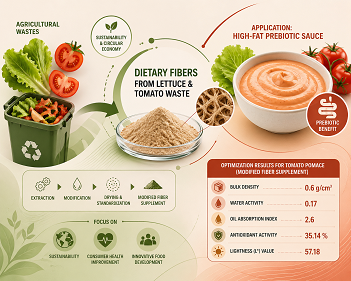
The utilization of dietary fibers extracted from agricultural wastes such as lettuce and tomato represents an innovative approach in developing food products focused on sustainability and consumer health improvement. This review article provides a comprehensive evaluation of the role of fibers derived from lettuce and tomato wastes in formulating high-fat prebiotic sauces. According to optimization results for tomato pomace aimed at producing a modified fiber supplement suitable for high-fat prebiotic sauce, the following properties were obtained: bulk density of 0.6 g/cm³, water activity of 0.17, oil absorption index of 2.6, antioxidant activity of 35.14%, and lightness (L*) value of 57.18. These findings indicate that tomato and lettuce waste fibers not only improve the technological and functional characteristics of sauces, but also support gut microbiota due to their prebiotic potential. Moreover, valorizing these agricultural by-products aligns with circular economy principles, reducing environmental impact while enhancing the nutritional profile of high-fat products. This review highlights the promising application of vegetable waste fibers as functional ingredients in the development of healthier, more sustainable sauce formulations

Graphical Abstract

A Review of the Quality Evaluation of High-Fat Prebiotic Sauce Containing Fiber Derived from Lettuce and Tomato Waste

Keywords

Subjects

OPEN ACCESS

©2026 The author(s). This article is licensed under a Creative Commons Attribution 4.0 International License, which permits use, sharing, adaptation, distribution and reproduction in any medium or format, as long as you give appropriate credit to the original author(s) and the source, provide a link to the Creative Commons license, and indicate if changes were made. The images or other third party material in this article are included in the article’s Creative Commons license, unless indicated otherwise in a credit line to the material. If material is not included in the article’s Creative Commons license and your intended use is not permitted by statutory regulation or exceeds the permitted use, you will need to obtain permission directly from the copyright holder. To view a copy of this license, visit: http://creativecommons.org/licenses/by/4.0/

PUBLISHER NOTE

Sami Publishing Company remains neutral concerning jurisdictional claims in published maps and institutional affiliations.

CURRENT PUBLISHER

Sami Publishing Company
[1] Niasati, S. Addition of dietary fiber extracted from olive by-products to a high-fat prebiotic sauce. Journal of Iranian Food Science and Technology, 2019 15(2), 123–134.
[2] Chang, C., Li, J., Li, X., Wang, C., Zhou, B., Su, Y., and Yang, Y. Effect of protein microparticle and pectin on properties of light mayonnaise. LWT - Food Science and Technology, 2017, 82, 8–14.
[3] Park, E.S., Moon, W.S., Song, M.J., Kim, M.N., Chung, K.H., & Yoon, J.S. Antimicrobial activity of phenol and benzoic acid derivatives. International Biodeterioration & Biodegradation, 2001, 47(4), 209–214.
[4] Olmez, E., Vural, K., Gok, S., Ozturk, Z., Kayalar, H., Ayhan, S., and Var, A. Olive leaf extract improves the atherogenic lipid profile in rats fed a high cholesterol diet. Wiley Online Library, 2015, 29(10), 1652–1657.
[5] Speroni, C.S., Bender, A.B.B., Stiebe, J., Ballus, C.A., Ávila, P.F., Goldbeck, R., Morisso, F.D.P., Silva, L.P. da, and Emanuelli, T. Granulometric fractionation and micronization: A process for increasing soluble dietary fiber content and improving technological and functional properties of olive pomace. LWT, 2020, 130, 109526.
[6] Slavin, J. Fiber and Prebiotics: Mechanisms and Health Benefits. Nutrients, 2013, 5(4), 1417-1435.
[7] Elleuch, M., Bedigian, D., Roiseux, O., Besbes, S., Blecker, C., and Attia, H. Dietary fibre and fibre-rich byproducts of food processing: Characterisation, technological functionality and commercial applications: A review. Food Chemistry, 2011, 124(2), 411–421.
[8] Roberfroid, M. Prebiotics: The Concept Revisited1. The Journal of Nutrition, 2007, 137(3), 830S-837S.
[9] Bindels, L.B., Delzenne, N.M., Cani, P.D., and Walter, J. Towards a more comprehensive concept for prebiotics. Nature Reviews Gastroenterology & Hepatology, 2015, 12(5), 303–310.
[10] Sang, J., Li, L., Wen, J., Gu, Q., Wu, J., Yu, Y., Xu, Y., Fu, M., and Lin, X. Evaluation of the Structural, Physicochemical and Functional Properties of Dietary Fiber Extracted from Newhall Navel Orange ByProducts. Foods, 2021, 10(11), 2772.
[11] Dilucia, F., Lacivita, V., Conte, A., and Del Nobile, M.A. Sustainable Use of Fruit and Vegetable By-Products to Enhance Food Packaging Performance. Foods, 2020, 9(7), 857.
[12] Marlett, J.A. Dietary Fiber and Cardiovascular Disease. Handbook of Dietary Fiber, 2001, 17–30.
[13] Abbattista, R., Ventura, G., Calvano, C.D., Cataldi, T.R.I., and Losito, I. Bioactive Compounds in Waste By Products from Olive Oil Production: Applications and structural Characterization by Mass spectrometry Techniques. Foods, 2021, 10(6).
[14] Arshad, M.T., Ikram, A., Ahmad, M., Maqsood, S., Hossain, M.S., and Gnedeka, K.T. Sensory characteristics, quality attributes, and storage stability of mayonnaise: a review. International Journal of Food Science and Technology, 2025, 60(2).
[16] Cardoso, S.M., Guyot, S., Marnet, N., Lopes-da-Silva, J.A., Renard, C.M.G.C., and Coimbra, M.A. Characterisation of phenolic extracts from olive pulp and olive pomace by electrospray mass spectrometry. Journal of the Science of Food and Agriculture, 2005, 85(1), 21–32.
[17] Rivas, M.A., Casquete, R., Benito, M.J., Martín, A., Dorado, T., and de Guía Córdoba, M. Enhancing tomato sauce quality by replacing sugar with wine lees dietary fiber. LWT – Food Science and Technology, 2024, 214, 117159.
[18] Tomas, M., Beekwilder, J., Hall, R.D., Simon, C.D., Sagdic, O., and Capanoglu, E. Effect of dietary fiber (inulin) addition on phenolics and in vitro bioaccessibility of tomato sauce. Food Research International, 2018, 106, 129–135.
[19] Tomas, M., Sagdic, O., Catalkaya, G., Kahveci, D., and Capanoglu, E. Effect of dietary fibre addition in tomato sauce on the in vitro bioaccessibility of carotenoids. Quality Assurance and Safety of Crops & Foods, 2018, 10(3), 277–283.
[20] Mohammadi, M. Addition of dietary fiber extracted from olive by-products to high-fat prebiotic sauce. Proceedings of the National Conference on Food Science and Technology, Iran. CIVILICA, 2025.
Volume 8, Issue 2
Spring 2026
Pages 73-77

  • Receive Date 29 March 2026
  • Revise Date 28 April 2026
  • Accept Date 12 May 2026