h-index: 6     i10-index: 4

Determination of Nitrogen and NPSB Fertilizer Rate on Production of Sweet Potato (Ipomoea batatas (L.) Lam) Yield and Yield Components in Bako and Wayu Tuka Districts, Western Oromia, Ethiopia.

Document Type : Original Article

Authors

Oromia Agricultural Research Institute, Bako Agricultural Research Center, Bako, Ethiopia

10.48309/jase.2026.580178.1107
Abstract
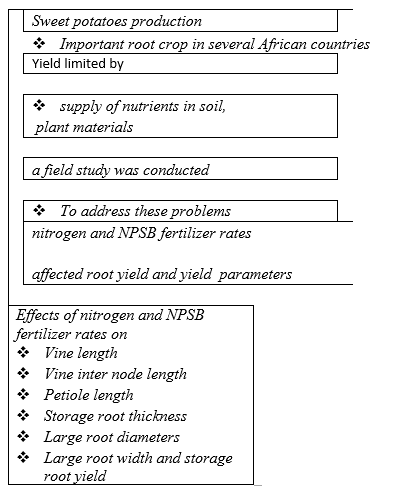
Sweet potatoes are the most important root crop in several African countries, including Ethiopia. Nevertheless, its development is hampered by the nutrients in soil and plant materials. To address these problems, a field study was conducted in the districts of Bako and Wayu Tuka during the 2023/2024 growing season to assess how fertilizer rates affected root yield and yield parameters. Four nitrogen levels (23, 46, 69, and 92) and three levels of NPSB kgha⁻¹ (100, 150, and 200) fertilizer rates were used in the experiment. It was set up in three replications using a factorial arrangement, RCBD. The study examined the effects of nitrogen and NPSB fertilizer rates on vine length, vine internode length, petiole length, storage root thickness, large root diameters, large root width, and storage root yield (57884 kg ha⁻¹) and recorded them from 69 kg N and 200 and 100 kg NPSB ha⁻¹ at the Bako and Gute sub-sites, respectively. The application of 69 ha⁻¹ nitrogen and (200 and 100) kg ha⁻¹ The NPSB fertilizer rate resulted in the highest yield of sweet potatoes (61,142.86 & 9,905 kg ha⁻¹) from the Bako and Gute locations, with the highest net benefit of 1,209,136 & 188,284.20 ETB ha⁻¹ with an acceptable marginal rate of return. According to the study's findings, sweet potato productivity and profitability in the Midland agro-ecologies of western Ethiopia are greatly increased by supplementing the optimum amount of nitrogen and NPSB fertilizer rates.

Graphical Abstract

Determination of Nitrogen and NPSB Fertilizer Rate on Production of Sweet Potato (Ipomoea batatas (L.) Lam) Yield and Yield Components in Bako and Wayu Tuka Districts, Western Oromia, Ethiopia.

Keywords

Subjects

OPEN ACCESS

©2026 The author(s). This article is licensed under a Creative Commons Attribution 4.0 International License, which permits use, sharing, adaptation, distribution and reproduction in any medium or format, as long as you give appropriate credit to the original author(s) and the source, provide a link to the Creative Commons license, and indicate if changes were made. The images or other third party material in this article are included in the article’s Creative Commons license, unless indicated otherwise in a credit line to the material. If material is not included in the article’s Creative Commons license and your intended use is not permitted by statutory regulation or exceeds the permitted use, you will need to obtain permission directly from the copyright holder. To view a copy of this license, visit: http://creativecommons.org/licenses/by/4.0/

PUBLISHER NOTE

Sami Publishing Company remains neutral concerning jurisdictional claims in published maps and institutional affiliations.

CURRENT PUBLISHER

Sami Publishing Company
[1] Awel, M. Evaluating the Performance of improved sweet potato (Ipomoea batatas) varieties at Shishir, Southern Ethiopia. International Journal of Research in Agriculture and Forestry, 2018. 8(9): 33-36.
[2] Fdre, C. Te federal democratic republic of Ethiopia central statistical agency report on area and production of crops. Te Federal Democratic Republic of Ethiopia Central Statistical Agency V, 2021, 128.
[3] Tigabu, B., and Tilahun, B. Performance evaluation of improved sweet potato (Ipomoea batatas L.) varieties at Gedeo Zone, Southern Ethiopia. International Journal of Science and Research, 2013. 4(9): 116-119.
[4] Tadele, Z. Raising crop productivity in Africa through intensification. Agronomy, 2017, 7(1): 22.
[5] Ledermann, S.T., Organic revolution: Cotton and its impact on poverty, inequality and sustainability in Tanzania. Rutgers The State University of New Jersey, School of Graduate Studies, 2012.
[9] Boliko, M.C., FAO and the situation of food security and nutrition in the world. Journal of nutritional science and vitaminology, 2019. 65(Supplement), S4-S8.
[10] Broadbent, F.E. The soil organic fraction. Advances in agronomy, 1953. 5, 153-183.
[11] Bray, E.A. Molecular responses to water deficit. Plant physiology, 1993, 103(4), 1035-1040.
[12] Zeinali, E., Khosravian, T., Soltani, A., and Moshiri, F. Estimation of the gap in nitrogen, phosphorus and potassium applied fertilizers for the production of plant produce in Golestan provinceJournal of Crop Production2025, 18(4), 1-22.
[14] Mengel, K. Responses of various crop species and cultivars to fertilizer application. Plant and Soil, 1983, 72(2), 305-319.
[15] Nelson, J.L., Kurtz, L.T., and Bray, R.H. Rapid determination of nitrates and nitrites. Analytical Chemistry, 1954, 26(6), 1081-1082.
Volume 8, Issue 2
Spring 2026
Pages 78-86

  • Receive Date 24 March 2026
  • Revise Date 11 May 2026
  • Accept Date 17 May 2026