h-index: 6     i10-index: 4

Biochemical Characterization and Sustainable Valorization of Mango (Mangifera indica L.) Seed Starch: Unlocking an Agro-Industrial Waste for Biopolymer Applications

Document Type : Review Article

Authors

1 Biotechnology Advanced Research Centre, Sheda Science and Technology Complex, P.M.B. 186, Garki, Abuja, Nigeria

2 Biochemistry Department of Ibrahim Badamasi Babangida University, Lapai, Niger State, Nigeria

3 Department of Biological Sciences, Federal University Dutse, P.M.B. 7156, Jigawa State, Nigeria

10.48309/jase.2026.580196.1106
Abstract
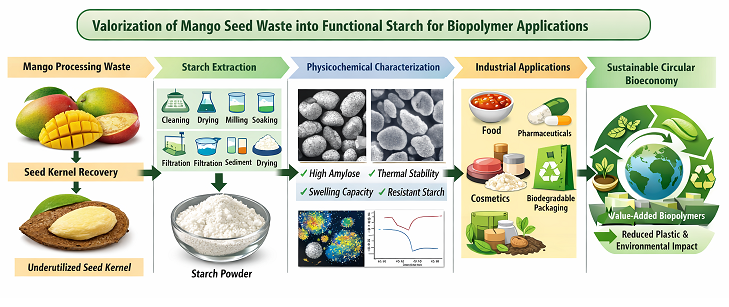
Starch is an essential biopolymer traditionally sourced from cassava, corn, and potato, with widely used applications in the food, pharmaceutical, and cosmetic industries due to its biodegradability, biocompatibility, and functional versatility. However, the growing demand for conventional starch sources raises sustainability and food security concerns. Mango (Mangifera indica L.) seeds, which constitute approximately 10–25% of the fruit’s total weight, are commonly discarded as agro-industrial waste byproduct despite being rich in starch. Mango seed starch has recently been used as an alternative source of starch due to its desirable physicochemical and functional properties. This review examines starch derived from mango seed kernels, with focus on its botanical origins, extraction techniques, physicochemical characteristics, nutritional significance, industrial applications, and associated limitations. Mango seed starch shows high amylose content, favorable swelling capacity, thermal stability, and potential health benefits, supporting its application in food, pharmaceutical, cosmetic, and biodegradable packaging industries. The review also highlights challenges limiting large-scale application, such as species variability, antinutritional compounds, inadequate processing setup, and regulatory constraints. Future research should focus on improved extraction and modification techniques, alongside sustainability assessments, to enhance the commercial viability and sustainable utilization of mango seed starch.

Graphical Abstract

Biochemical Characterization and Sustainable Valorization of Mango (Mangifera indica L.) Seed Starch: Unlocking an Agro-Industrial Waste for Biopolymer Applications

Keywords

Subjects

OPEN ACCESS

©2026 The author(s). This article is licensed under a Creative Commons Attribution 4.0 International License, which permits use, sharing, adaptation, distribution and reproduction in any medium or format, as long as you give appropriate credit to the original author(s) and the source, provide a link to the Creative Commons license, and indicate if changes were made. The images or other third party material in this article are included in the article’s Creative Commons license, unless indicated otherwise in a credit line to the material. If material is not included in the article’s Creative Commons license and your intended use is not permitted by statutory regulation or exceeds the permitted use, you will need to obtain permission directly from the copyright holder. To view a copy of this license, visit: http://creativecommons.org/licenses/by/4.0/

PUBLISHER NOTE

Sami Publishing Company remains neutral concerning jurisdictional claims in published maps and institutional affiliations.

CURRENT PUBLISHER

Sami Publishing Company
[1] Kaur, A., Singh, N., Ezekiel, R. Biodegradable starch-based materials: A review. Carbohydrate Polymers, 2019, 213, 289-302.
[2] Moorthy, S.N. Physicochemical and functional properties of tropical tuber starches: A review. Starch/Stärke, 2002, 54(12), 559-592.
[4] Food and Agriculture Organization (FAO). FAOSTAT statistical database. FAO, 2023.
[5] Sogi, D.S, Siddiq, M., Roidoung. S., Dolan, K.D. Total phenolics, carotenoids, ascorbic acid, and antioxidant properties of fresh-cut mango slices and puree during storage. Journal of Food Processing and Preservation, 2015, 39(6), 1071-1078.
[6] Tahir, H.E., Xiaobo, Z., Mahunu, G.K., Aruna, A. Mango seed kernel: Nutritional composition, phytochemicals and potential applications in the food industry. Food Science Journal, 2020, 36(5), 456-469.
[7] Ahmad, M., Gani, A., Shah, A., Masoodi, F.A. Mango seed kernel: A potential source of bioactive compounds and its utilization in food. Journal of Food Science and Technology, 2021, 58(6), 2062-2072.
[8] Sukhija, S., Singh, S., Riar, C.S. Extraction and characterization of starch from mango seed kernel. International Journal of Food Properties, 2016, 19(3), 578-594.
[9] Chaudhary, A., Yadav, R.B., Singh, N. Extraction and functional evaluation of starch from mango seed kernel for industrial applications. International Journal of Biological Macromolecules, 2022, 195, 135-143.
[10] Singh, Z., Singh, R.K., Sane, V.A., Nath, P. Mango. In: Nath, P., Bouzayen, M., Mattoo, A.K., Pech, J.C. Fruit Ripening: Physiology, Signalling and Genomics. CAB International, 2013, 221-239.
[12] Othman, R.A., Widyaningsih, T.D., Hanim, C. Mango production and postharvest systems in Indonesia. Acta Horticulturae. 2014, 1011, 181-190.
[13] Zaidel, D.N.A., Chin, N.L., Yusof, Y.A., Talib, R.A. Mango seed kernel and its application in food processing: A review. Journal of Food Science and Technology, 2018, 55(3), 1029-1041.
[14] Ruales, J., Zumba, J., Cevallos-Cevallos, J. Isolation and characterization of starch from mango seed kernel. Starch/Stärke. 2016, 68, 850-857.
[15] Fuentes-Zaragoza, E., Riquelme-Navarrete, M.J., Sánchez-Zapata, E., Pérez-Álvarez, J.A. Resistant starch as a functional ingredient: A review. Food Research International, 2010, 43(4), 931-942.
[16] Lauricella, M., Emanuele, S., Calvaruso, G., Giuliano, M., D’Anneo, A. Multifaceted health benefits of mangiferin. BioFactors, 2017, 43(5), 495-506.
[18] Adebowale, K.O. Functional properties of tropical starches. International Journal of Biological Macromolecules, 2022.
[19] Rathi, R.R., Rajput, H.H., Rajput, A.A. Development and evaluation of mango seed starch as a pharmaceutical excipient. Asian Journal of Pharmaceutical Sciences, 2018, 12(4), 1221-1226.
[20] Santos, J.S., Freitas, M., Bracht, A., Oliveira, L.C., Peralta, R.M. Modified starches: Production, properties and applications. Food Hydrocolloids, 2021, 111, 106400.
[21] Torres-León, C., Ramírez-Guzman, N., Ascacio-Valdés, J., Serna-Cock, L., dos Santos Correia, M.T., Contreras-Esquivel, J.C., Aguilar, C.N. Agro-industrial waste valorization: Scientific and technological advances. Food Research International, 2018, 112, 254–271.
[22] Ashogbon, A.O., Akintayo, E.T. Isolation, composition, morphological and pasting properties of starches from rice cultivars grown in Nigeria. Starch/Stärke, 2014, 66, 41–48.
[23] Jan, K.N., Panesar, P.S., Singh, S. Structural, thermal and rheological properties of starches isolated from Indian mango cultivars. International Journal of Biological Macromolecules, 2016, 89, 263–270.
[24] Jiménez, A., Fabra, M.J., Talens, P., Chiralt, A. Edible and biodegradable starch films: A review. Food and Bioprocess Technology, 2012, 5, 2058–2076.
[25] Averous, L., Pollet, E. Environmental Silicate Nano-Biocomposites. Springer-Verlag London, 2012.
[27] Pelissari, F.M., Andrade-Mahecha, M.M., Sobral, P.J.A., Menegalli, F.C. Isolation and characterization of the flour and starch of plantain bananas. Starch/Stärke, 2012, 64(5), 382–391.
[28] Shah, U., Naqash, F., Gani, A., Masoodi, F.A. Art and science behind modified starch edible films and coatings: A review. Comprehensive Reviews in Food Science and Food Safety, 2016, 15(3), 568–580.
[29] Falguera, V., Quintero, J.P., Jiménez, A., Muñoz, J.A., Ibarz, A. Edible films and coatings: Structures, active functions and trends in their use. Trends in Food Science & Technology, 2011, 22(6), 292–303.
[30] Mali, S., Grossmann, M.V.E., García, M.A., Martino, M.N., Zaritzky, N.E. Barrier, mechanical and optical properties of plasticized yam starch films. Carbohydrate Polymers, 2006, 63(4), 587–596.
Volume 8, Issue 2
Spring 2026
Pages 87-96

  • Receive Date 23 March 2026
  • Revise Date 14 May 2026
  • Accept Date 18 May 2026