h-index: 6     i10-index: 4

Azurin from Pseudomonas aeruginosa and its insecticidal activity against Spodoptera frugiperda (J.E. Smith)

Document Type : Original Article

Author

Insect Population Toxicology Department, Central Agricultural Pesticides Laboratory, Agriculture Research Center, 12618, Giza, Egypt

10.48309/jase.2026.578998.1103
Abstract
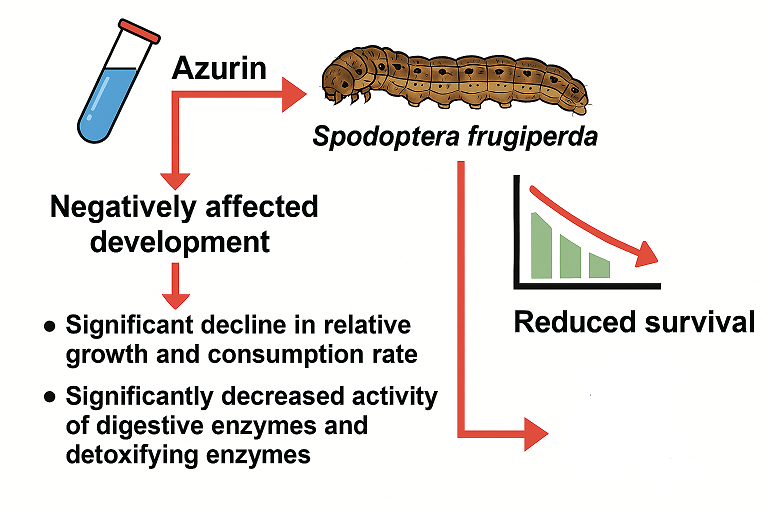
Fall armyworm, Spodoptera frugiperda (Lepidoptera: Noctuidae), is a major pest of maize, and its control requires the use of insecticides. The increasing prevalence of insecticide resistance in S. frugiperda highlights the urgent need for new, effective, and environmentally safe strategies. Azurin, a redox-active protein produced by Pseudomonas aeruginosa, was evaluated for its insecticidal potential against S. frugiperda larvae. Biochemical assays measured the effects on nutritional physiology and enzymatic activities in larvae. Larval bioassays revealed that azurin exhibited potent toxicity, with an LC₅₀ values of 94.40, 42, 13.30, 3.55 µg/mL after 24, 48, 72 and 96 h, respectively of exposure. The larval mortality rate increased in a time- and dose-dependent manner. Azurin also negatively affected the development of insect along with significant decline in relative growth and consumption rate as well as efficiency of conversion of ingested and digested food of insect. The azurin significantly decreased the reproductive potential of insect. A significantly decrease in the activity of various digestive enzymes and detoxifying enzymes was also observed that might be associated with reduced survival of this insect. These results suggest that azurin exhibits significant larvicidal activity and the ability to disrupt S. frugiperda metabolism functions, making it a promising candidate for controlling this pest.

Graphical Abstract

Azurin from Pseudomonas aeruginosa and its insecticidal activity against Spodoptera frugiperda (J.E. Smith)

Keywords

Subjects

[1] Erenstein, O., Jaleta, M., Kai Sonder, K., Mottaleb, K., Prasanna, B.M. Global maize production, consumption and trade: trends and R&D implications. Food Security, 2022, 14, 1295-1319.
[2] Wang, G., Zhang, X. Maize in Global Food Security: Role and Challenges. Field Crop. 2024, 7(3).
[3] Chisonga, C., Chipabika, G., Sohati, P.H., Harrison, R.D. Understanding the impact of fall armyworm (Spodoptera frugiperda J. E. Smith) leaf damage on maize yields. PLoS ONE. 2023, 18(6), e0279138.
[4] Ismail, S.M. Field efficacy of seed treatment recent insecticides in maize on fall armyworm (Spodoptera frugiperda J. E. Smith) and crop performance. Journal of Agricultural Sciences and Engineering, 2024, 6(4), 218-223.
[5] FAOStat. FAO Stat. FAO, Rome, 2021.
[6] Aleem, K., Imran, M., Bashir, S., Pernia, A., Manzoor, M., Anwar, M.S., Akbar, M., Munawar, I. Integrated pest management strategies for invasive fall armyworm. Agrobiological Records, 2023, 12, 53-59.
[8] Jeger, M., Bragard, C., Caffier, D., Candresse, T., Chatzivassiliou, E., Dehnen‐Schmutz, K., Gilioli, G., et al. Pest categorisation of Spodoptera frugiperda. EFSA Journal, 2017, 15(7), e04927.
[9] Yang, X., Liu, M., Zhang, F., Meng, X. Microbial-derived bioactive substances:  Sources, identification, and application in fruit disease Management. Food Reviews International, 2025, 2613-2633.
[10] Hu, J., Jiang, W., Zuo, J., Shi, D., Chen, X., Yang, X., et al. Structural basis of bacterial effector protein azurin targeting tumor suppressor p53 and inhibiting its ubiquitination. Communications Biology, 2023, 6, 59.
[11] Shuaib, H., Saleem, M.Z., Alshahrani, M.Y., Suliman, M., Hani, U., Nadeem, T., Tahir, S., Akram, M., Samreen, O., Bashir, H. Development and bioactivity assessment of a recombinant Pseudomonas aeruginosa azurin-BR2 peptide fusion protein: A novel approach to cancer immunotherapy. Journal of Biological Regulators and Homeostatic Agents, 2024, 38(7).
[12] Kowalczyk, T., Merecz-Sadowska, A., Synowiec, E., Sliwinski, T., Piekarski, J., Szemraj, J., Mori, M., Rijo, P., Sitarek, P. The production of recombinant azurin from Pseudomonas aeruginosa and its ability to induce apoptosis in various breast cancer cell lines. International Journal of Molecular Sciences. 2025.
[13] Sereena, M.C., Sebastian, D. Evaluation of anticancer and anti-hemolytic activity of azurin, a novel bacterial protein from Pseudomonas aeruginosa SSj. International Journal of Peptide Research and Therapeutics, 2020, 26, 459-466.
[14] Unver, Y., Yildiz, S., Acar, M. Extracellular production of azurin from Pseudomonas aeruginosa in the presence of Triton X-100 or tween 80. Bioprocess and Biosystems Engineering, 2022, 45(3), 553-561.
[15] Riegerová, P., Horváth, M., Šebesta, F., Sýkora, J., Šulc, M., Vlček, A. Single-step purification and characterization of Pseudomonas aeruginosa azurin. Protein Expression and Purification, 2024, 224, 106566.
[16] Bernfeld, P. Amylase α and β. Methods in Enzymology, 1955, 1, 149-158.
[17] Ranjbar, M., Zibaee, A., Sendi, J.J. Purification and characterization of a digestive lipase in the midgut of ectomyelois ceratoniae zeller (lepidoptera: Pyralidae). Frontiers in Life Science, 2015, 8(1), 64-70.
[18] García‐Carreño, F.L., Haard, N.F. Characterization of proteinase classes in langostilla (pleuroncodes planipes) and crayfish (pacifastacus astacus) extracts. Journal of Food Biochemistry, 1993, 17(2), 97-113.
[19] Shabarari, M., Naseri, B. Characterization of digestive α- and β-glucosidases in the midgut of Plagiodera versicolora Laicharting (Coleoptera: Chrysomelidae). Journal of Entomological Society of Iran. 2016, 35(4), 45-51.
[20] Ellman, G.L., Courtney, K.D., Andres, Jr.V., Feather-stone, R.M. A new and rapid colorimetric determination of acetylcholinesterase activity. Biochemical Pharmacology, 1961, 7(2), 88-95.
[21] van Asperen, K. A study of housefly esterases by means of a sensitive colorimetric method. Journal of Insect Physiology, 1962, 8(4), 401-16.
[22] Habig, W.H., Pabst, M.J., Jakoby, W.B. Glutathione S-transferases: the first enzymatic step in mercapturic acid formation. Journal of biological Chemistry, 1974, 249(22), 7130-9.
[23] Jang, J.Y., Yang, S.Y., Kim, Y.C., Lee, C.W., Park, M.S., Kim, J.C., Kim, I.S. Identification of or amide A as an insecticidal metabolite produced by Pseudomonas protegens F6. Journal of Agricultural and Food Chemistry, 2013, 61(28), 6786–6791.
[25] Vacheron, J., Péchy-Tarr, M., Brochet, S., Heiman, C.M., Stojiljkovic, M., Maurhofer, M., Keel, C. T6SS contributes to gut microbiome invasion and killing of an herbivorous pest insect by plant-beneficial Pseudomonas protegens. The ISME Journal, 2019, 13(5), 1318-1329.
[26] Suganthi, M., Senthilkumar, P., Arvinth, S., Chandrashekara, K.N. Chitinase from Pseudomonas fluorescens and its insecticidal activity against Helopeltis theivora. Journal of General and Applied Microbiology, 2017, 63(4), 222-227.
[27] Wei, J.Z., O’Rear, J., Schellenberger, U., Rosen, B.A, Park, Y.J, McDonald, M.J., et al. A selective insecticidal protein from Pseudomonas mosselii for corn rootworm control. Plant Biotechnology Journal, 2018, 16(2), 649-659.
[29] Rodrigues, J.D.B., Moreira, R.O., de Souza, J.A.M., Desiderio, J.A. Interaction of insecticidal proteins from Pseudomonas spp. And Bacillus thuringiensis for boll weevil management. PLoS ONE, 2023, 18(11), e0294654.
[30] Liu, F.H., Lin, X.L., Kang, Z.W., Tian, H.G., Liu, T.X. Isolation and characterization of Pseudomonas cedrina infecting Plutella xylostella (Lepidoptera: Plutellidae). Archives of Insect Biochemistry and Physiology, 2019, 102(3), e21593.
[31] Sarkhandia, S., Devi, M., Sharma, G., Mahajan, R., Chadha, P., Saini, H.S., Kaur, S. Larvicidal, growth inhibitory and biochemical effects of soil bacterium, Pseudomonas sp. EN4 against Spodoptera litura (Fab.) (Lepidoptera: Noctuidae). BMC Microbiology, 2023, 23, 95.
Volume 8, Issue 2
Spring 2026
Pages 97-109

  • Receive Date 24 March 2026
  • Revise Date 13 May 2026
  • Accept Date 20 May 2026